
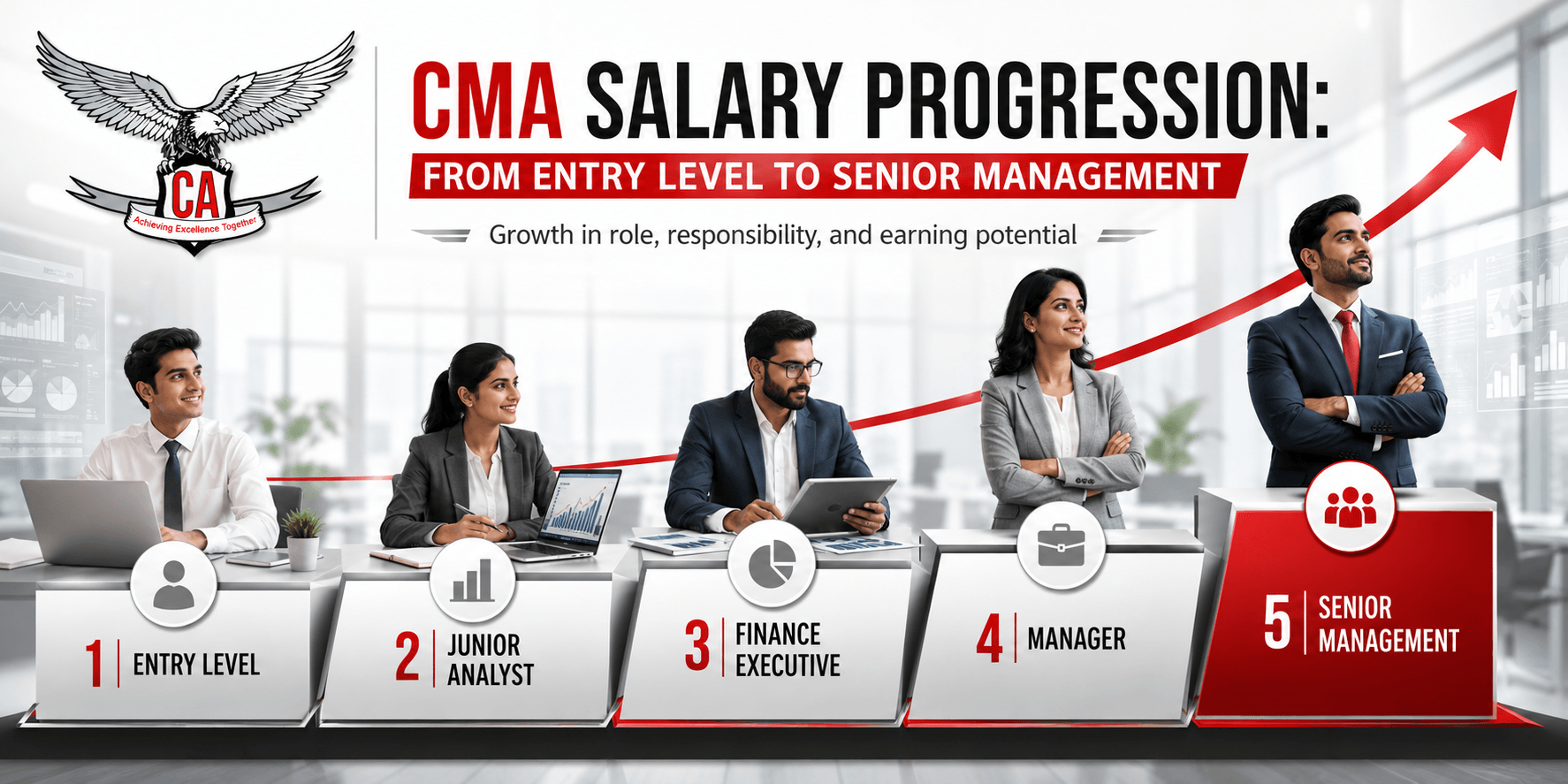
CMA salary progression in India depends on more than passing examinations. Experience, industry, location, digital skills and leadership responsibility affect how quickly earnings grow. A newly qualified CMA may begin as a cost accountant, finance executive or analyst before progressing to finance manager, controller, finance director or CFO. These are indicative ranges because employers report compensation differently.
CMA Salary Progression at a Glance
Salary growth accelerates when a CMA moves into forecasting, financial planning and analysis, and decision support. In mid-2026, Glassdoor reported a typical Indian cost accountant salary range of about ₹4.63 lakh to ₹11.49 lakh and an FP&A manager range of about ₹14.35 lakh to ₹29.25 lakh. ICMAI’s recommended corporate stipend for CMA Final-qualified trainees ranges from ₹37,000 to ₹50,000 per month, depending on city category and training year.
Career stage | Experience | Common roles | Estimated annual salary |
| CMA fresher | 0–2 years | Trainee, finance executive, junior analyst | ₹3.6–₹7.2 lakh |
| Junior level | 2–5 years | Cost accountant, analyst, internal auditor | ₹6–₹12 lakh |
| Mid-level | 5–10 years | Finance manager, costing manager, FP&A manager | ₹10–₹22 lakh |
| Experienced manager | 8–12 years | Controller, commercial finance manager | ₹15–₹30 lakh |
| Senior management | 12–18 years | Finance head, general manager finance | ₹25–₹60 lakh |
| Director or CFO | 15+ years | Finance director, VP Finance, CFO | ₹40 lakh–₹1 crore+ |
These ranges summarise the supplied salary framework and are not fixed pay scales.
CMA India vs US CMA
In India, “CMA” may mean CMA India or US CMA, which differ in professional recognition and career application.
CMA India
CMA India is the Cost and Management Accountancy qualification administered by the Institute of Cost Accountants of India, a statutory professional body. It covers costing, taxation, auditing, financial reporting and corporate decision-making. Under ICMAI’s current scheme, applicable students must complete 15 months of practical training before the relevant Final result deadline.
US CMA
The US CMA is offered by the Institute of Management Accountants and focuses on planning, performance management, internal controls, analytics, corporate finance and risk management. Candidates must also complete two continuous years of relevant management accounting or financial management experience.
Factor | CMA India | US CMA |
| Governing body | ICMAI | IMA |
| Main focus | Costing, reporting, taxation and corporate finance | Planning, performance, analytics and strategic finance |
| Common roles | Cost accountant, finance manager, auditor, controller | Management accountant, FP&A analyst, finance business partner |
| Best suited for | Indian industry and corporate finance | Multinational finance and FP&A |
CMA Salary Progression by Experience
Progression reflects increasing responsibility, especially ownership of financial analysis, internal controls, teams and business decisions.
Entry-Level CMA Salary: 0–2 Years: An entry-level CMA may earn around ₹3.6 lakh to ₹7.2 lakh annually, although actual offers vary by employer, location and placement route.
Common Entry-Level Roles and Skills: Common roles include cost accounting trainee, finance executive and junior financial analyst. Employers usually value accurate accounting, Microsoft Excel, reconciliations, cost sheets, basic financial reporting and professional communication.
Junior-Level CMA Salary: 2–5 Years: A CMA with two to five years of relevant experience may earn approximately ₹6 lakh to ₹12 lakh annually. Salary growth improves when the professional independently manages budgets, management reports, cost analysis or internal controls. Analytical responsibility is often more valuable for long-term progression than a higher job title alone.
Mid-Career CMA Salary: 5–10 Years: Mid-career CMAs may earn around ₹10 lakh to ₹22 lakh, with specialised FP&A managers sometimes earning more. Glassdoor’s July 2026 data placed the typical Indian FP&A manager range at ₹14.35 lakh to ₹29.25 lakh. Professionals at this level are expected to lead forecasts, supervise teams and advise management on financial performance.
Senior CMA Salary: 10–15 Years: A senior CMA may earn approximately ₹18 lakh to ₹45 lakh, depending on company size and the scope of responsibility. Common roles include financial controller, head of costing, head of FP&A and general manager of finance. Compensation may combine fixed salary, performance bonuses, retirement benefits, allowances and equity incentives.
CMA Salary at Leadership Level: 15+ Years: Experienced CMAs can progress to finance director, vice president of finance or chief financial officer. Packages may begin around ₹40 lakh and exceed ₹1 crore in large organisations, but executive compensation varies widely. Employers at this level evaluate governance experience, leadership ability and measurable business impact more than the professional qualification alone.
CMA Salary by Job Role
Job title influences salary because different finance roles carry different levels of responsibility and business impact.
Job role | Typical experience | Indicative annual salary |
| Cost accountant | 0–7 years | ₹4.6–₹11.5 lakh |
| Financial analyst | 1–6 years | ₹4–₹12 lakh |
| FP&A manager | 5–12 years | ₹14.4–₹29.3 lakh |
| Finance manager | 5–12 years | ₹9–₹25 lakh |
| Financial controller | 8–18 years | ₹15–₹50 lakh+ |
| Chief financial officer | 15+ years | ₹40 lakh–₹1 crore+ |
Salary platforms generally rely on employee submissions, so candidates should compare several sources and match salary benchmarks to the responsibilities of the actual role.
Factors That Influence CMA Salary Growth
Long-term CMA salary growth is shaped by responsibility, employer size, professional skills and measurable performance.
Industry, Employer and Location: Manufacturing, financial services, technology, consulting, pharmaceuticals and FMCG can provide strong opportunities for CMA professionals. Multinational companies often offer structured salary bands and international exposure, while smaller businesses may provide broader responsibilities earlier. Large cities may offer more specialised finance roles, but living expenses should be considered when comparing packages.
Technical and Digital Skills: Advanced Excel, ERP systems, Power BI, SQL, financial modelling and automation can improve reporting quality and financial analysis. The US CMA examination formally includes technology and analytics, reflecting the growing importance of digital finance skills. Practical projects that demonstrate improved reporting, forecasting or controls usually carry more value than software certificates alone.
Leadership and Business Understanding: Higher-paying CMA roles require professionals to explain financial results, challenge assumptions, manage teams and support commercial decisions. Understanding pricing, working capital, customer profitability and investment returns helps CMAs progress from accounting support roles into finance management and leadership.
How to Increase Your CMA Salary Faster
Freshers should complete practical training seriously, develop Excel and ERP skills and document examples of real work. Professionals with two to five years of experience should take ownership of budgets, forecasts or internal controls and record measurable achievements. Mid-career CMAs should seek team leadership and cross-functional exposure, while senior professionals should develop board-level communication, industry expertise and business transformation experience.
Typical CMA Career Roadmap
The following roadmap shows a common progression from practical training to executive finance leadership.
Career period | Possible roles | Main development priority |
| Years 0–2 | Trainee or finance executive | Accuracy and practical skills |
| Years 2–5 | Cost accountant or financial analyst | Process ownership and analysis |
| Years 5–10 | Finance manager or FP&A manager | Leadership and business partnering |
| Years 10–15 | Financial controller or finance head | Strategy and governance |
| Years 15+ | Finance director or CFO | Enterprise and board leadership |
This roadmap is not fixed. Strong mentorship, employment in a high-growth industry, technology skills and measurable business results can accelerate CMA career progression, while repetitive responsibilities and limited professional development can delay it.
Is CMA a High-Paying Career?
CMA can become a high-paying career in FP&A, financial controllership, consulting and executive finance, but the qualification does not guarantee an immediate high salary. IMA’s 2023 Global Salary Survey reported that CMA-certified respondents earned 21% more in median total compensation than non-CMAs globally. However, this represents a survey association and does not prove that certification alone caused the difference.
Conclusion
CMA salary progression can develop from an entry-level package of approximately ₹3.6 lakh to ₹7.2 lakh into senior management compensation of ₹25 lakh to ₹60 lakh and, in some organisations, ₹1 crore or more at CFO level. Faster progression usually requires practical training, financial analytics, ERP knowledge, communication skills and leadership experience. Salary figures should be treated as planning ranges, while career decisions should focus on building valuable experience, taking greater responsibility and delivering measurable business results.